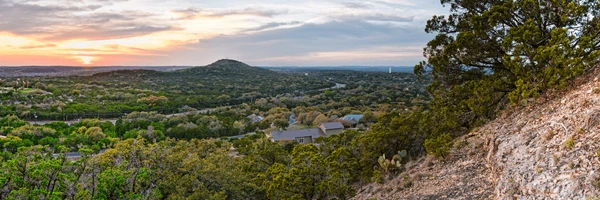
By Billy Rhyne, owner of Horseshoe Ridge RV Resort in Wimberley · Updated October 2026
Long-term RV parks in Texas usually rent sites for 30 days or more at a monthly rate. To compare them, add up the base rate, electric, monthly fees and the cost of getting where you need to go. Then check the agreement, the rig and pet rules, the internet and whether the exact site fits your RV. The best park is the one that fits your rig, season, budget and daily routine, not the one with the lowest advertised rate.
I own Horseshoe Ridge RV Resort in Wimberley, and we host long-term guests all year: snowbirds, remote workers, traveling nurses, retirees near family, people between houses. When someone calls about a monthly site, the first questions aren't about the pool. They're about rig length, slides, the tow vehicle, the dates and how they'll use the site every day. This guide is what I'd tell a friend to check before choosing any long-term RV park in Texas, ours or anyone else's. Our own answers are in one section near the end.
What counts as a long-term RV stay in Texas?
A long-term RV stay usually means 30 days or more. "Monthly campground," "extended-stay RV park" and "long-term RV park" mostly describe the same thing: you rent a site by the month instead of by the night. The label matters less than the written terms.
| Stay type | Typical length | How it's usually priced | Best fit |
|---|---|---|---|
| Nightly or weekly | Under 30 nights | Per night or week; weekends and seasons change the rate | Road trips and short visits |
| Monthly | 30 nights or more | Monthly base rate; electric often separate | Work assignments, remote work, family visits, relocations |
| Seasonal | Several months with set dates | Monthly rate, sometimes lower for longer stays | Snowbirds and Winter Texans |
| Longer agreement | Fixed term or ongoing month-to-month | Written terms for deposit, notice and renewal | Full-timers, retirees, long contracts |
Don't assume "monthly" means utilities are included or that the stay renews on its own. Ask for the agreement before you pay a deposit.
Can you live in an RV park full time in Texas?
Yes, you can live full time in a Texas RV park when the park permits long-term occupancy and applicable local rules allow it. Some parks welcome year-round guests; others cap stays, reserve monthly sites for certain seasons or require a fixed agreement.
Living in an RV park and living in an RV on your own land are different questions. A park already has its permitted use and its rules. Private land comes with city zoning, county rules, deed restrictions or HOA covenants, and utility and septic requirements.
Can I buy land and live in an RV in Texas?
Sometimes, but it depends on the specific property. No Texas state law bans living in an RV full time; where you can do it is decided by city zoning, county rules and deed restrictions. If you're looking at rural land, plan on a permitted septic system, a legal water source and an electric hookup, and check the deed and the county before you buy. Don't rely on a listing that says "unrestricted" without checking for yourself.
Do you pay property tax on an RV in Texas?
Generally not, for an RV you use yourself. In Texas, a motorhome, travel trailer or fifth wheel that isn't producing income generally isn't subject to annual property tax; you pay vehicle registration fees through your county tax office instead (Texas Comptroller). Manufactured homes are treated differently. If your situation is unusual, ask your county appraisal district.
What about mail?
Ask each park directly. Some accept letters and packages and some don't, and a park's mail policy is separate from whether you can stay there. Many full-time RVers who travel use a Texas mail-forwarding service instead, but if you plan to get a Texas driver license, check with DPS first. Its rules require a Texas residence address and do not accept a PO box or business address as the residence (37 Tex. Admin. Code §15.25).
What does a long-term RV park in Texas cost each month?
Monthly RV site rent in Texas varies widely. Listings checked in October 2026 put many rural and small-town parks around $350–$650 a month, while sites near Austin and other metros, and at resort-style parks, commonly run $800 to $1,000 or more. Electricity is often billed separately (Texas long-term listings; Texas RV-lot listings). The winter Gulf Coast also runs high in season.
That advertised rate is only the first line. Compare parks on the total:
Monthly total = base rate + electric + monthly fees + propane and laundry + getting around
| Cost | What to ask | Why it changes the total |
|---|---|---|
| Base rate | Is this the rate for my dates and site type? Is there a lower rate for 3+ months? | Seasonal and promotional rates come with conditions |
| Electric | Included, metered or flat fee? What's the rate per kWh? | Summer air-conditioning use can make the electric bill materially higher |
| Deposit | How much, what can be deducted, when is it returned? | Affects your move-in cash and the cost of changing plans |
| Monthly fees | Pets, extra vehicles, guests, internet, admin? | Small fees add up over a long stay |
| One-time charges | Application, processing, cancellation? | The lowest rate can come with the highest move-in cost |
| Propane and laundry | Filled on site? Coin laundry? | Routine costs after the first week |
| Storage and packages | Storage units? Will they hold packages? | Off-site options add cost and driving |
| Getting around | How far to work, family, groceries, medical care? | A cheaper site 40 minutes out can cost more than a closer one |
Ask the park to put the rate, what's included, the deposit and the major fees in writing.
Is living in an RV park cheaper than an apartment?
It can be, especially if you already own the RV, but compare totals, not site rent against apartment rent. On the RV side add electric, propane, insurance, maintenance, registration and any RV loan. On the apartment side add utilities, renter's insurance and parking. Then add the commute to both.
Is electricity included in a monthly RV site?
Not necessarily. Many Texas parks meter electricity at the site and bill it separately; others include it or charge a flat fee. In hot months, air-conditioning use can make the bill materially higher.
Ask four questions:
- What's the price per kWh?
- When is the meter read?
- Is electric billed monthly or at checkout?
- What does a rig like mine typically use here in this season?
The math is simple: at $0.10 per kWh, 500 kWh is $50 and 1,000 kWh is $100. Your own past summer usage is a better starting point than a statewide residential average, because parks set their own per-kWh price and every rig is different. Shade and site orientation may reduce cooling demand, so ask which sites get afternoon shade.
Month-to-month or a fixed agreement: what are you signing?
Month-to-month gives you flexibility; a fixed or seasonal agreement trades some of it for set dates and sometimes a lower rate. Whatever the website calls it, the written agreement is what counts.
| Term | Month-to-month | Fixed or seasonal agreement |
|---|---|---|
| Commitment | One month at a time | Set arrival and departure dates |
| Rate | Usually the standard monthly rate | Sometimes a lower longer-stay rate |
| Leaving or extending | Notice period set by the park | The agreement controls changes |
| Leaving early | Notice or processing fees may apply | You may lose a deposit or owe a fee |
| Site | Subject to availability and park policy | The park may assign your site |
| Best fit | Uncertain work dates, trying out an area | Snowbird seasons, fixed contracts |
Read four things twice: the total due at move-in, the notice to leave or extend, the deposit-return conditions and what happens if your plans change.
What park rules should you check before committing?
Long-term RV parks commonly have rules covering rigs, pets, vehicles, guests and use of the site. Ask about them before you drive in or pay anything nonrefundable:
- RV age and condition. Is there an age limit? Will they consider an older rig with photos?
- Exact site fit. Total length, slide layout, axles, tow vehicle or towed car.
- Pets. How many, breed or behavior rules, records, leash rules, fees.
- Screening. Is there an application, ID check or background check for long stays?
- Vehicles and visitors. How many vehicles fit, where extras park, how overnight guests register.
- Your site. Are outdoor storage, skirting, rugs, plants or sheds allowed?
- Repairs and generators. Can you work on your rig at the site? When can a generator run?
- Mail and packages. What can be delivered, and can you use the park's address?
- Quiet hours and how repeated problems are handled.
- Subleasing. Usually not allowed.
- Weather. What do guests need to do before a freeze, a storm or an evacuation?
- Leaving. How much notice, and what condition the site should be in.
A rule isn't a bad sign. What matters is that it's written down, consistently applied and compatible with how you plan to live.
Where in Texas should you stay long term?
Pick the region by season and by where you need to be every day, then compare parks. Texas is big enough that a winter on the coast and a summer in the Hill Country are completely different stays.
| Region | Often best for | What drives cost and demand | What to check |
|---|---|---|---|
| Hill Country (Austin–San Antonio corridor) | Remote workers, retirees near family, people who want quiet within reach of two cities | Closeness to Austin; resort amenities | Summer electric, commute time, fall and winter availability |
| Gulf Coast | Winter stays, fishing, the beach | Distance to the water; winter demand | Humidity, evacuation plans, hurricane season (June 1–November 30) |
| Rio Grande Valley | Winter Texans and retirees | Peak winter demand, roughly November–March | Book early; summers are very hot |
| Metros: Austin, San Antonio, Houston, DFW | Work assignments, medical access, relocations | Distance to jobs and major roads | Traffic, waitlists, noise, the real door-to-door commute |
| East Texas Piney Woods | Lakes, trees, small-town stays | Distance from big job centers | Humidity, storms, internet |
| West Texas and the Panhandle | Industry work, travelers who want space | Local job cycles | Wind, freezes, summer sun, long drives for supplies |
Looking for a long-term RV park near Austin? Decide how long a commute you'll accept before you sort by price. A park outside the city often gives you more space and quiet, but only if the drive fits your work or family schedule.
Where are cheaper long-term RV parks in Texas?
Lower rates are more common away from the big metros and outside the coast's winter peak: small towns, East Texas and parts of West Texas. But the lowest base rate isn't always the lowest monthly total once you add fuel, electric, fees and the distance to groceries, work and medical care.
What is the best long-term RV park in Texas?
The best long-term RV park in Texas is the one that fits your rig, your season, your total budget and your daily drive. Score each park you're considering on five questions:
- Does the exact site fit your RV, slides and vehicles?
- What will the stay cost after electric, fees and driving?
- Does the agreement match how certain your dates are?
- Are the internet, mail, laundry and services good enough for daily life?
- Is it in the right region for the season and the places you need to reach?
A resort with a pool and fiber internet is right for one guest. A simple monthly campground next to a jobsite is right for another.
How do Texas seasons affect long-term RV living?
The same park is a different place in January and August, so plan for the season you'll actually be there.
- Summer: air conditioning drives your electric bill. Ask about the kWh rate, shade and what happens in a power outage.
- Hurricane season on the coast (June 1–November 30, with peak activity from mid-August to mid-October): ask how the park sends alerts, what its evacuation plan covers and what remains the guest's responsibility.
- Winter freezes: even central Texas gets hard freezes. Ask whether skirting is allowed and what the park expects guests to do to protect hoses, connections and holding tanks.
- Winter Texan season (about November–March): the Valley and the coast fill up, and popular inland parks get busier too. Call early if you want specific dates or a specific site.
What is the 3-3-3 rule for RV travel?
The 3-3-3 rule is a travel-pacing guideline, not a park rule. A common version means driving no more than about 300 miles a day, arriving by 3 p.m. and staying at least three nights; some versions instead say to stop every three hours. For a long-term move, the useful part is arriving with enough daylight to solve a site-fit or hookup problem without rushing.
Which amenities matter most on a long stay?
On a weekend, the pool is the headline. After three weeks, you notice the everyday things.
| Amenity | Why it matters long-term | What to ask |
|---|---|---|
| Internet | Work calls and streaming every day | Hardwired connection, shared Wi-Fi or both? Any device or usage limits? |
| Power and hookups | You run everything, all day | 20/30/50-amp service? Water and sewer at the site? |
| Pad and drainage | Leveling, mud, daily setup | Concrete, gravel or grass? How does it drain? |
| Laundry | Weekly chore | How many machines, what hours? |
| Trash | Daily | Pickup at your site or a central dumpster? |
| Propane | Heat and cooking | Filled on site, picked up, delivered, or do you haul it? |
| Mail and packages | Work and life admin | What can the park accept, and where is it held? |
| Pets | Daily walks | Pet limit, walking space, dog park, fees |
| Community and quiet | It's your neighborhood | Quiet hours, events, visitor rules |
| Weather plans | Freezes and storms | Alerts, shutoffs, evacuation |
"Wi-Fi available" isn't a full answer for a remote worker. Ask whether it reaches your exact site and whether there's a hardwired connection.
Questions to ask before you sign
Ask for the exact site, the full price and the written rules before you pay. If a park can't answer those three clearly, keep looking.
How do you find a monthly RV site that's open now?
Call with your exact dates, rig length, slides, vehicles and pets. Ask whether the quoted site is available for your entire stay, whether flexible arrival dates open more options and whether there's a waitlist. Because availability changes, call the park even if its website doesn't show your dates.
Checklist (keep it open when you call):
- What's the monthly rate for my dates and my exact site?
- Does that rate require a three-, six- or twelve-month commitment?
- What's due before arrival, including the deposit and one-time fees?
- Is electric included or metered? What's the rate per kWh?
- What monthly fees apply to pets, vehicles, guests or internet?
- How much notice do I need to leave or extend?
- What happens to my deposit if plans change?
- Are there rig age or condition rules, photo approval or screening?
- Which site fits my rig, slides and vehicles?
- What are the pet, visitor, storage, repair, generator and skirting rules?
- Is the internet hardwired at the site, or shared Wi-Fi?
- Can I get mail and packages here?
- How do you handle freezes, storms and power outages?
- Can I see a photo or map location of my exact site?
- Will you put the rate and major terms in writing?
How we handle long-term stays at Horseshoe Ridge
At Horseshoe Ridge RV Resort, a monthly stay is 30 nights or more, and we set it up by phone. Before we match you with a site we ask for your dates, RV length, slides and axles, tow vehicle, pets and internet needs. Here's how we answer the checklist:
| Question | Our answer |
|---|---|
| Minimum stay and booking | 30 nights or more, booked by phone so we can confirm dates and site fit. |
| Monthly rate | From $999 a month plus electric, or $849 a month plus electric when you stay 3+ months (we assign your site). Current rates are on our monthly RV stays page. |
| Electric | Metered at your site and billed at $0.10 per kWh. |
| Example month | $999 + 600 kWh of electric ($60) = about $1,059 before propane or other applicable charges. Your usage depends on your rig and the season. |
| Sites and hookups | Full hookups at every site (water, sewer, 20/30/50-amp) on concrete pads, with big-rig pull-throughs. |
| Internet | Fiber Wi-Fi across the property plus hardwired internet at every site's pedestal. |
| Trash and propane | Valet trash. Valet propane service is included: we pick up your cylinders at your site, fill them and bring them back, and you pay only for the propane. |
| Pets | Non-aggressive pets welcome, up to 3 per site. Leash and waste rules apply. |
| Rig rules | RVs older than 10 years need our approval before check-in. |
| Changing plans | Request extensions by phone with at least 30 days' notice; extensions remain subject to availability. Cancelling: a $35 processing fee more than 14 days out and $250 inside 14 days. Deposit terms are in your monthly agreement. |
| Other rules | Quiet hours 10 PM–8 AM. Visitors register at the front desk. No subleasing. Generators only with written permission. |
| Location | Ranch Road 12 in Wimberley, between Austin and San Antonio: about 45 minutes to Austin, about 70 minutes to San Antonio, 8–10 minutes to Wimberley Square. |
That's why we'd rather talk than take a monthly booking online: a rate alone can't tell us whether a site fits your rig, your dates and your daily routine.
Planning a long stay in the Texas Hill Country?
See our monthly sites and rates, or call us with your dates and rig details.