If you’re comparing the best RV parks in Texas, the short answer is that the strongest picks cluster in Texas Hill Country — the stretch between Austin and San Antonio where luxury RV resorts, family campgrounds, and riverfront getaways sit within a short drive of each other. We’ve put together 8 top picks to help you match a park to the kind of trip you’re planning, with Horseshoe Ridge RV Resort in Wimberley leading the list.
How did we pick these 8 RV parks?
We focused on the parks that deliver three things most Texas RV travelers actually want — full hookups with reliable internet, resort-style amenities that justify the trip out, and easy access to the region’s best attractions. Beyond that, we weighed site quality (concrete pads, big-rig-friendly layouts), on-site recreation, lodging variety for mixed groups, and the type of traveler each park serves best.
The result is a mix that covers most trip types: luxury and family resorts in Hill Country, a practical highway base for travelers passing through, an East Texas woodland option, and a riverfront pick for families who want to be on the water. Hill Country anchors the list because that’s where the strongest cluster of top-rated parks sits — and where most travelers planning a Texas RV trip end up.
The 8 best RV parks in Texas
1. Horseshoe Ridge RV Resort — Wimberley (Hill Country)
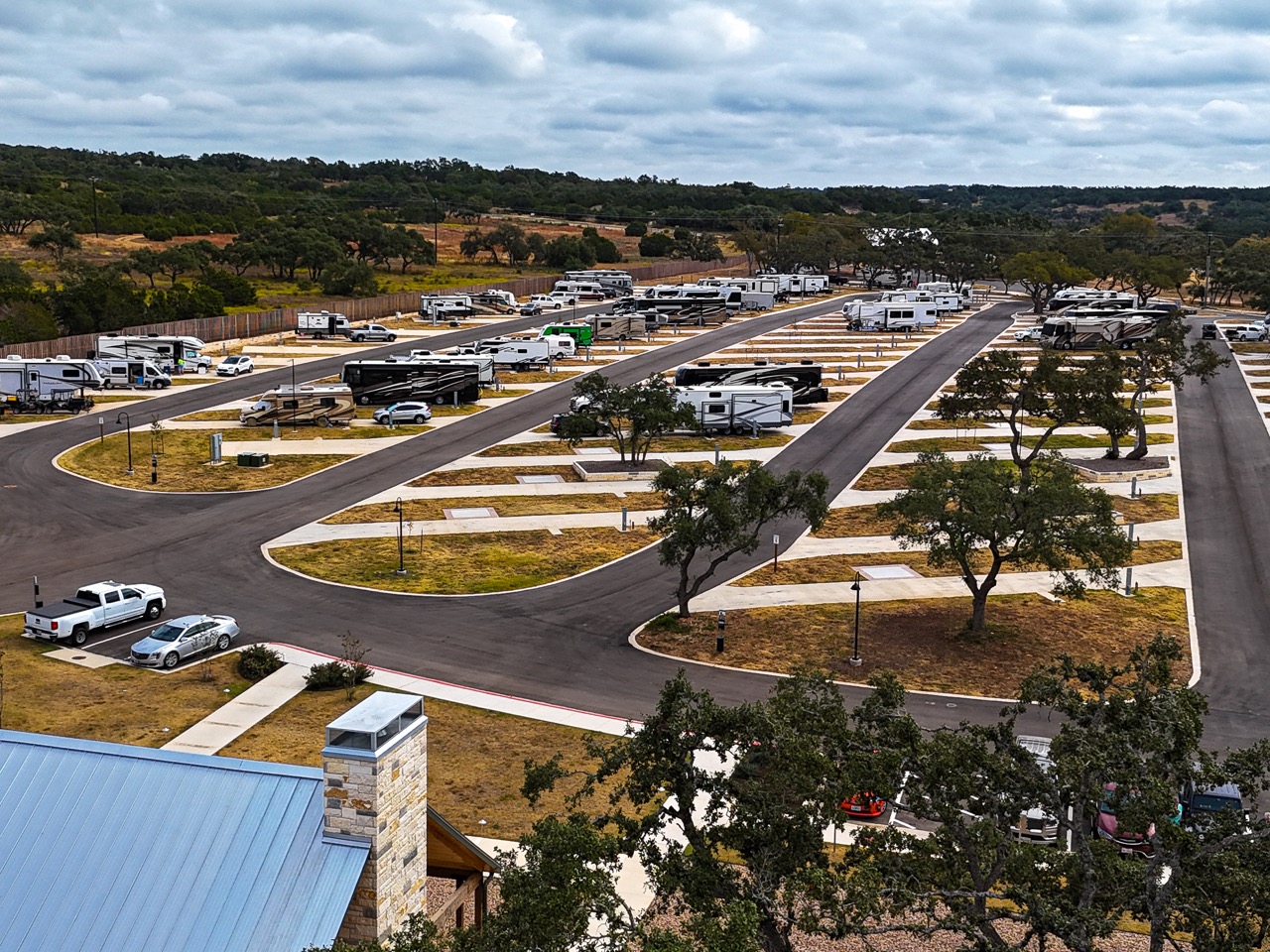
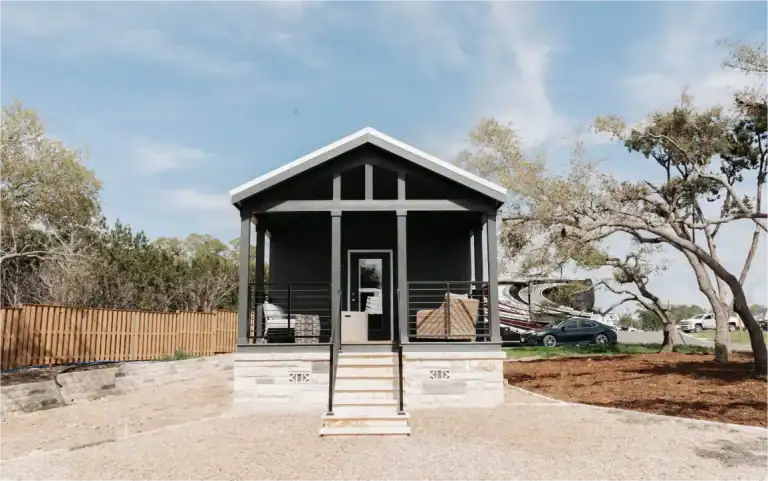
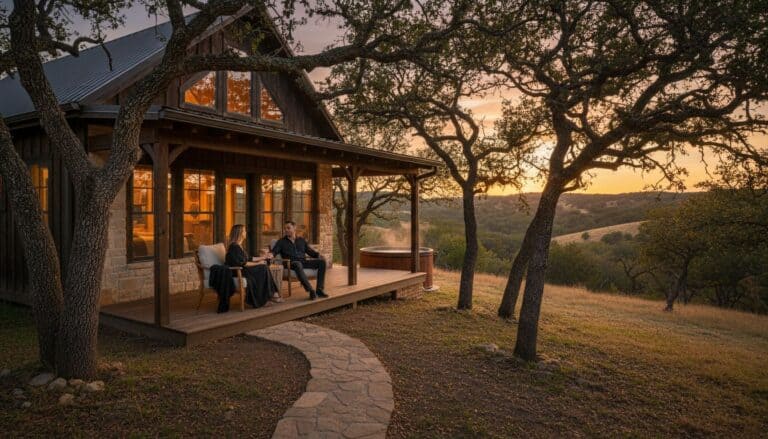
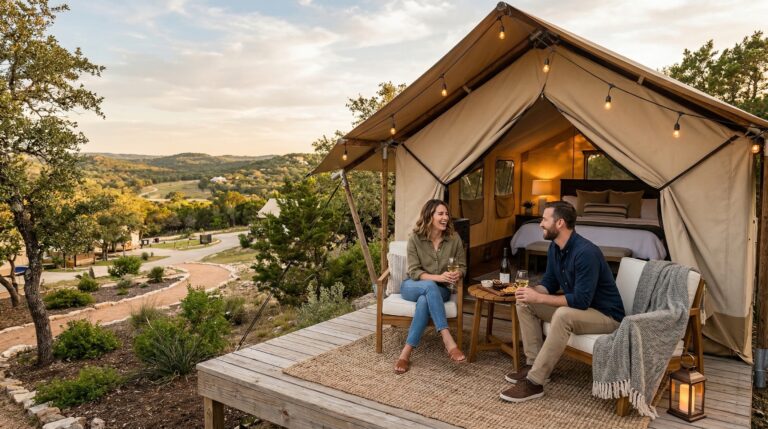
Horseshoe Ridge is a luxury RV resort in the middle of Texas Hill Country with 124 full-hookup sites, three furnished cabins, and resort-grade amenities on a shaded 31-acre property. Each site includes water, sewer, 30/50-amp electric, and high-speed fiber Wi-Fi with hardwired internet — the combination remote workers and snowbirds actually need.
The on-site amenities read more like a boutique hotel than a campground: a sunset-view resort pool, pickleball courts, a 34-foot pavilion fireplace, communal fire pits, outdoor grills, a 24/7 Trading Post, and a spa-like bath house with individual restrooms and showers. Three fully furnished cabin rentals give non-RV travelers and mixed groups a comfortable indoor option without leaving the resort. Monthly stays are available for full-timers and seasonal RVers who want a stable, amenity-rich base.
The location is the other half of the story — central Hill Country between Austin (45 minutes) and San Antonio (70 minutes), with Jacob’s Well and Blue Hole minutes away, plus wineries, swimming holes, and historic small towns in every direction.
Best for: Families, couples, remote workers, and monthly RVers who want resort-level amenities and central Hill Country access.
2. Yogi Bear’s Jellystone Park™ Hill Country — Canyon Lake
Jellystone Park™ Hill Country is an award-winning, family-first campground built around water play, themed events, and structured kids’ programming. The property pairs a water playground and multiple swimming pools with mini golf, a jumping pillow, sports courts, and a junior ranger program that keeps kids busy from morning to evening.
Accommodations span cabins, RV sites, and tent sites, which makes it easy to combine grandparents in a cabin with younger family in an RV. The park runs year-round, with peak season May through August, and themed weekends (including a big Halloween celebration) give returning guests reasons to book different times of year. Expect resort fees on top of the headline rate and busy summer weekends — book ahead for holidays. If you’re planning a Hill Country trip with kids, this is the activity-rich pick on our list. You can compare it against other family-focused options in our roundup of the best family-friendly RV resorts in Texas.
Best for: Families and multigenerational groups who want nonstop kid programming and on-site water amenities.
3. Buckhorn Lake Resort — Kerrville
Buckhorn Lake Resort is a straightforward full-service RV resort just off I-10 at Exit 501, built for travelers who want a dependable Hill Country base rather than on-site programming. Each site is fully landscaped with a concrete pad and full hookups, and the wide paved roads make it one of the easier parks in the region for big rigs to maneuver.
The trade-off is that there’s less to do on property — no pool details, no organized recreation, no resort programming. That’s the point. Buckhorn is positioned as a launching pad for day trips to Fredericksburg, Bandera, Boerne, Luckenbach, and San Antonio (about an hour away). If your trip is structured around exploring the region rather than staying put, this is the practical pick.
Best for: Couples and families using the resort as a day-trip base, big rigs needing easy access, and travelers who don’t need on-site entertainment.
4. Mill Creek Ranch Resort — Canton (East Texas)
Mill Creek Ranch Resort spreads across 200 acres of East Texas woods near Canton and combines 100 full-service RV sites with fully furnished cottages — useful when part of your group prefers four walls. The wooded setting feels more secluded than most Hill Country options, and the on-site amenity mix is unusually broad: a hot tub, a children’s playhouse, a dog park, horseshoe pits, and a nine-hole disc golf course.
The biggest reason to put this park on your list is timing — Canton hosts First Monday Trade Days, the largest flea market in the country, and Mill Creek is the cleanest place to stay nearby. Outside of Trade Days weekends, it’s a peaceful family or couples’ getaway with fishing, paddleboarding, and bird watching on the property.
Best for: East Texas travelers, Canton Trade Days shoppers, families wanting wooded acreage, and groups mixing cottage and RV stays.
5. Canopy RV Resort — New Braunfels
Canopy RV Resort is a gated luxury RV community in New Braunfels with oversized sites, concrete patios, and secured high-speed internet at every pedestal. The site design is the standout feature — each spot has room to park two additional vehicles, and 25-foot-wide asphalt roads make maneuvering large rigs noticeably easier than most parks.
The vibe is quieter and more residential than a typical campground. No highway or railroad noise, a gated entry, and resort amenities like a pool, pickleball courts, and green spaces. It’s a strong fit for long-term RVers, remote workers who need a peaceful basecamp, and families wanting room to spread out. Pricing isn’t listed publicly, so plan to call for current rates.
Best for: Long-term RVers, remote workers, and families who prioritize space and security over high-energy activities.
6. Skyline Ranch RV Park and Cabins — Bandera
Skyline Ranch sits on the Medina River about a mile from historic Bandera, the self-styled Cowboy Capital of the World. The park combines 103 RV sites (with pull-through options for big rigs) with cabins and recreation halls, plus river frontage and nature trails that give the place a real outdoor-Texas character.
The picnic area overlooks the river, the trails are good for birding and wildlife viewing, and there’s enough event space for family reunions or small group gatherings. High-speed Wi-Fi runs across the property, so remote workers won’t struggle. The trade-off is variable seclusion — some sites feel tucked away, others feel closer to the action — so site selection matters when you book.
Best for: Riverfront fans, fishing and birding enthusiasts, families with big rigs, and group gatherings.
7. Peach Country RV Park — Stonewall
Peach Country RV Park is a friendly 72-site park in Stonewall, right in the heart of Texas wine country and minutes from Fredericksburg. Every site is level, fully hooked up (50-/30-/20-amp), and paired with a cement patio and picnic table — the basics done well, without unnecessary complexity.
The location is the real draw. You’re a short drive from dozens of Hill Country wineries, the LBJ National Historical Park, and Luckenbach for live music. There’s an on-site cabin for non-RV guests, a spacious clubhouse for group gatherings, and a porch with rocking chairs aimed at the sunset. The recreation hall closes for private events from November through March, so winter visitors should expect fewer organized activities.
Best for: Wine country day-trippers, history buffs visiting the LBJ site, and travelers who want a quiet, comfortable basecamp.
8. Medina Highpoint Resort — Medina
Medina Highpoint Resort delivers a peaceful, nature-forward escape in the western Hill Country with the broadest lodging mix on our list — cabins with full kitchens, tent sites, RV sites, and an on-site ranch house large enough for group reunions. The infinity pool overlooks a scenic pond, and the property leans into outdoor programming with hiking, cave exploration, live music, and evening firepits.
If you’re planning a multi-generational reunion, a wedding, or a trip where part of the group wants to camp and part wants four walls, this is the most flexible single-property option in the region. Wi-Fi can be spotty in some spots, so remote workers should plan for the gaps, and the location is genuinely remote — which is the charm, but also the logistics.
Best for: Multigenerational reunions, mixed-lodging groups, couples wanting a nature escape, and families who value scenery over connectivity.
How the 8 RV parks compare at a glance
Rates vary by site type, season, and stay length — contact each park directly for current pricing.
How do you choose the right Texas RV park for your trip?
Match the park to the trip. Families with kids gravitate to Jellystone for the water park and structured programming. Couples and remote workers do better at Horseshoe Ridge or Canopy — quieter, with the kind of Wi-Fi that handles real work. Long-haul travelers passing through pick Buckhorn or Peach Country, where the resort itself isn’t the destination.
If you’re planning a romantic getaway, prioritize parks with secluded sites, scenic views, and a quieter atmosphere — Horseshoe Ridge, Canopy, and Medina Highpoint all read that way. For multi-generational reunions, lodging variety becomes the key filter: Medina Highpoint, Mill Creek, and Horseshoe Ridge all offer cabin-plus-RV combinations that let everyone stay on one property.
For monthly or long-term stays, the calculus shifts. Reliable fiber Wi-Fi, a stable community feel, and proximity to grocery and medical services start to matter more than pool size. Horseshoe Ridge and Canopy lead on that combination — and for a deeper look at what makes a long-term RV stay work in Texas, our guide to the best long-term RV resort in Texas covers the criteria in detail.
Site type is the other underrated decision. Pull-through sites are easier to arrive and leave from, which matters for short stays and big rigs. Back-in sites usually offer more privacy and better views. If you’re not sure which works for your rig, the booking team at any of these parks can walk you through the options before you reserve.
When is the best time to visit Texas RV parks?
Spring (March through May) and fall (September through November) are the sweet spots — mild temperatures, lower crowds at the family parks, and the Hill Country wildflower bloom runs late March through April. Bluebonnets, Indian paintbrush, and Mexican hat fill the roadsides, and the weather sits in the high 60s to low 80s during the day.
Summer (June through August) is peak season at the family-focused parks with water amenities — Jellystone fills up fast on weekends, and rates climb. It’s also the hottest stretch of the year, so shaded sites and pool access become priorities. Winter brings snowbirds escaping northern climates, which is when monthly stays at parks like Horseshoe Ridge and Canopy peak.
For more on timing, route planning, and what to pack, our guide on how to plan the perfect RV trip to Texas Hill Country walks through the seasonal considerations in detail.
What should you look for in a Texas Hill Country RV park?
Three things matter most: site type, connectivity, and amenity depth. Site type covers whether the park accommodates your rig length, offers pull-through or back-in (or both), and has the right amp service (50-amp is standard for big rigs, 30-amp works for most travel trailers). Big-rig friendliness is genuinely variable across Hill Country parks, so confirm before you book.
Connectivity is no longer optional. Fiber Wi-Fi has become the line between resort-tier parks and everyone else — hardwired internet at each pedestal, not just shared Wi-Fi that drops at 4 PM. If you’re working remotely or streaming, prioritize parks that publish their internet setup clearly.
Amenity depth is what separates an RV park from an RV resort. Pool, pickleball, fire pits, cabin rentals for mixed groups, a Trading Post or general store, and clean bath house facilities all push a park into resort territory. For a closer look at what makes Hill Country resorts distinct, our guide on what makes Texas Hill Country resorts unique covers the regional features in more depth.
Why travelers pick Horseshoe Ridge as their Hill Country base
How to book your stay at Horseshoe Ridge
Frequently asked questions about Texas RV parks
What are the best RV parks in Texas?
What’s the best region in Texas for RV parks?
What amenities should I look for in a Texas RV park?
Are Texas RV parks pet-friendly?
When is the best time to visit Texas RV parks?
Can you stay long-term at Texas RV parks?