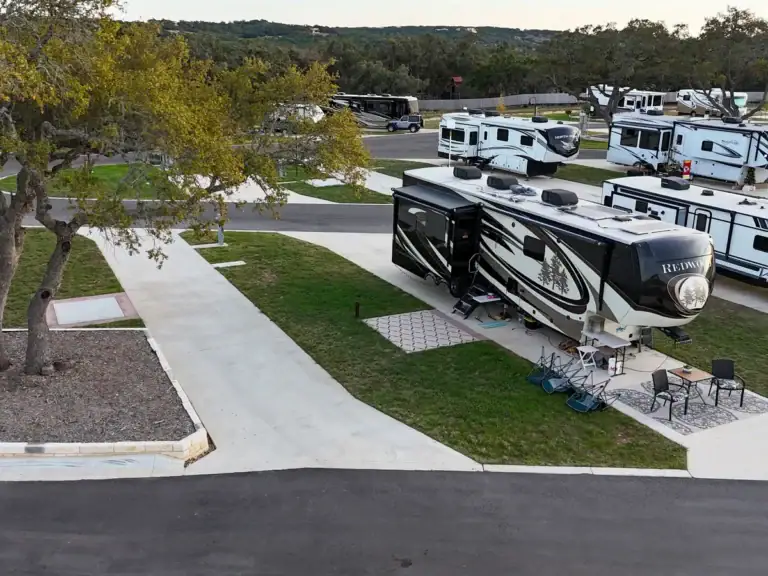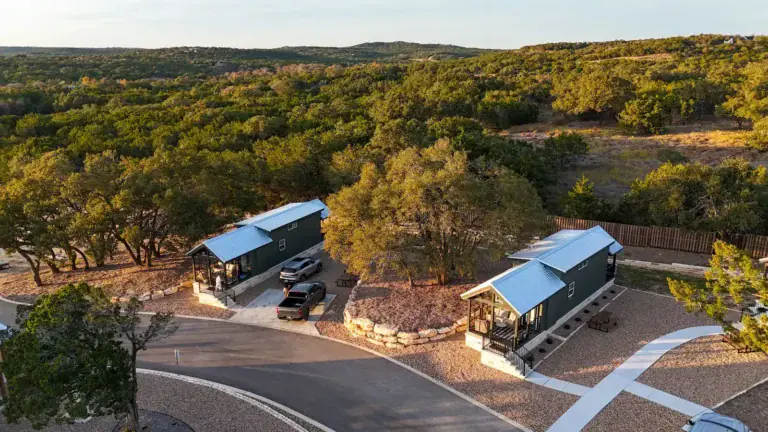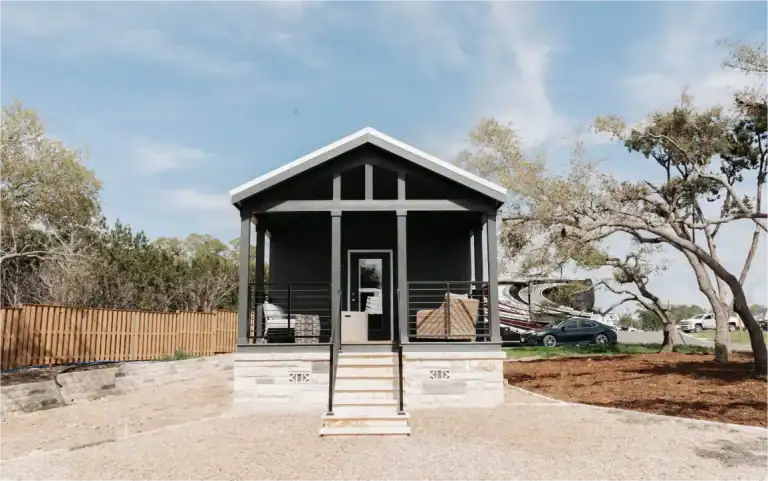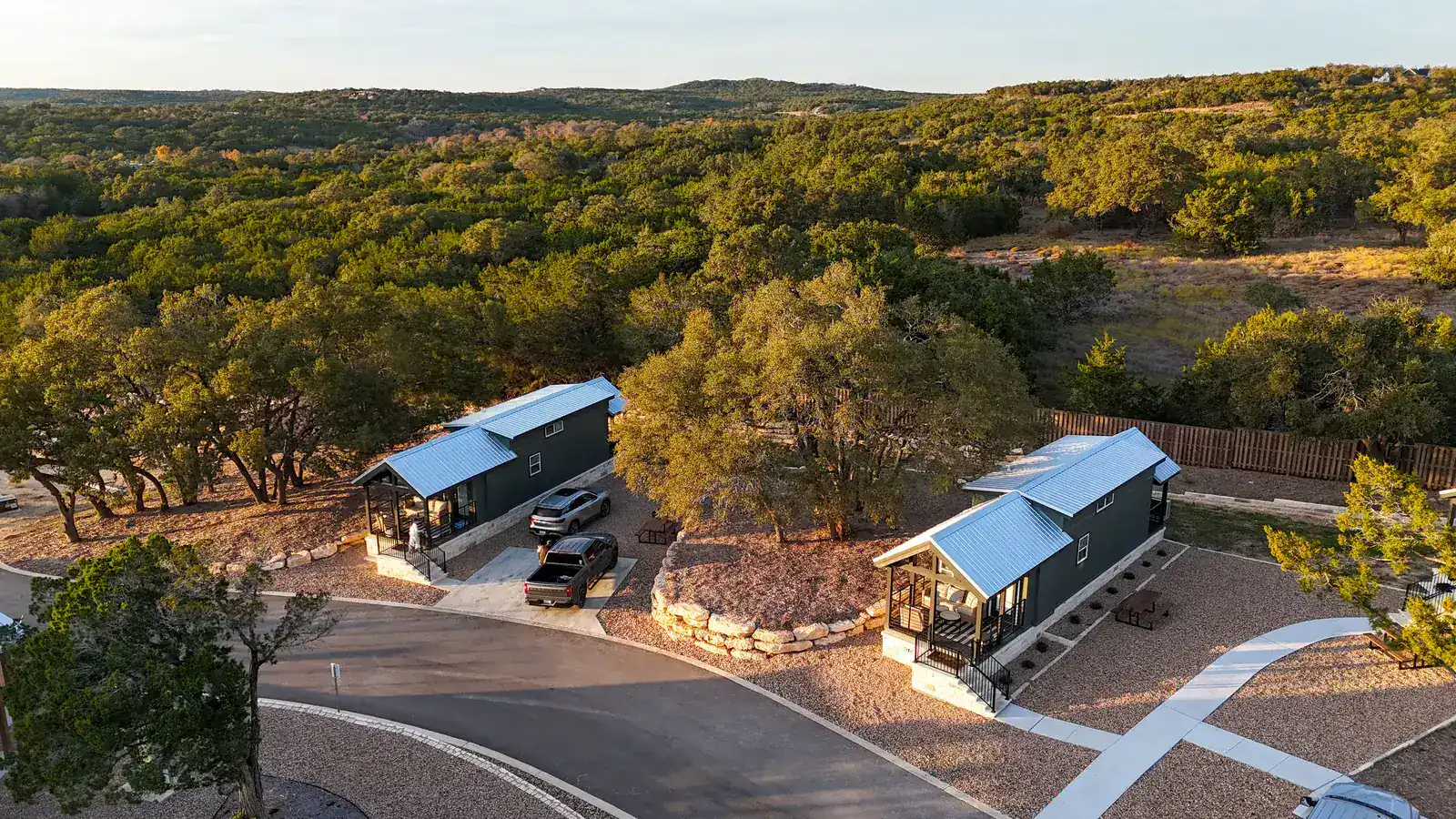
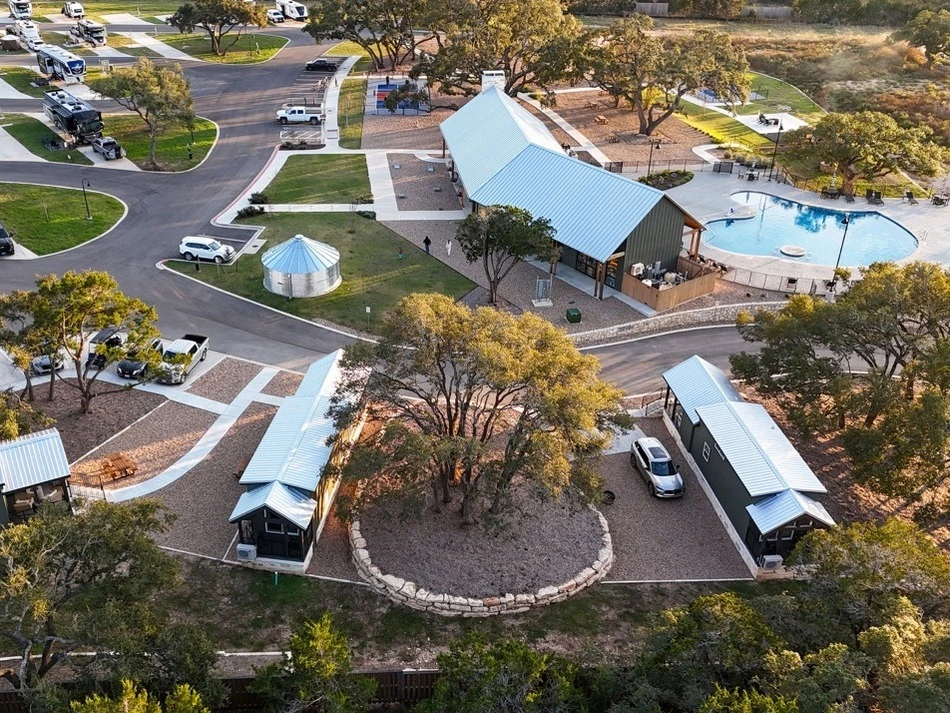
Here at Horseshoe Ridge RV Resort, the glamping-versus-camping question comes down to one trade-off: comfort and convenience against lower cost and full self-reliance. If you want resort comforts near Wimberley, our luxury cabins and full-hookup RV sites sit firmly on the glamping end of that spectrum.
Glamping gives you a furnished, serviced stay with a real bed, power, and private facilities. Camping means bringing and setting up your own shelter and gear at a tent or primitive site.
Glamping trades a higher nightly rate for a furnished, serviced stay with no gear and no setup; camping trades comfort for lower cost and deeper immersion. For a Hill Country trip with reliable Wi-Fi, private bathrooms, and pet-friendly sites, glamping or a full-hookup RV site fits best.
Glamping vs. Camping: A Quick Definition
Glamping and camping differ mainly by comfort and service:
Plenty of stays fall between the two, and our cabin rentals are a good example of the glamping middle ground.
The term "glamping" dates to the early 2000s, a blend of "glamour" and "camping."
What Each Stay Actually Provides
Glamping delivers the comforts of home without the setup:
Resort staff typically handle check-in, setup and maintenance.
Luxury RV sites add full hookups and pedestal power, hardwired internet or fiber at the pedestal, level pads, and on-site amenities. You can see the tiers on our full-hookup RV sites page.
Traditional camping puts you in charge: you supply the shelter, sleeping bag, stove or fire setup, water, and trash. Cost is lower per night, but the gear and effort are yours.
Which Option Fits Your Trip to Wimberley?
If you want resort-style comforts, reliable internet for remote work, and easy pet policies, glamping or a luxury RV site will fit best. Horseshoe Ridge offers full-hookup, fiber-enabled stays and cabins that blend modern convenience with Texas Hill Country views, minutes from the best things to do in Wimberley.
If you would rather rough it near a river or trail, a primitive campsite or state-park tent site will feel more authentic.
Use this quick self-check before you book:
How Do Glamping and Camping Compare Overall?
At Horseshoe Ridge, we offer the comfort-forward side of the outdoors, and the choice comes down to convenience versus do-it-yourself adventure. Here is a side-by-side to help you weigh sleep, facilities, effort, and budget.
| Attribute | Glamping at Horseshoe Ridge | Traditional Camping | Our Take |
|---|---|---|---|
| Comfort & Sleep | Furnished bedding in our cabins (RV guests bring their own), so you arrive rested | You bring a sleeping pad, air mattress, or bag; rest depends on your gear | Glamping for hotel-like sleep, camping for gear-based simplicity |
| Bathrooms & Sanitation | Private or resort restrooms and showers on-site | Shared or primitive facilities; portable solutions may be needed | Glamping for private facilities, camping for a rustic feel |
| Setup & Effort | Little to no setup; units are prepared by staff | You pitch and break camp yourself | Glamping for a low-prep arrival and more leisure time |
| Amenities & Services | Pool, fire pits, fiber Wi-Fi, and an on-site store | Minimal or none; bring water, cooking gear, entertainment | Glamping for resort conveniences, camping for self-reliance |
| Cost | Higher nightly rate reflecting furnishings and upkeep | Lower per night, but gear costs add up upfront | Budget travelers lean camping; comfort seekers lean glamping |
| Privacy & Noise | Landscaped, spaced sites reduce the unpredictable | Closer to raw nature, with more ambient sound | Glamping for quiet privacy, camping for raw immersion |
| Accessibility | Many units and resort paths are easier to reach | Primitive terrain and tent entry can be difficult | For mobility needs, glamping or an RV site is usually the better fit |
A common first-timer question is what to expect on bedding, power, and packing. At Horseshoe Ridge, cabins and glamping-style stays typically include bedding, so you can leave the sleeping bag and pad at home. Always confirm the specifics on your reservation.
How Much Does Glamping Cost Compared With Camping?
Glamping generally costs more per night than traditional camping because you are paying for furnishings, utilities, and service. Industry data such as KOA's North American Camping Report shows consistently higher average fees for cabin- and glamping-style stays than for primitive tent sites, and exact prices vary by season and what's included.
The nightly rate is only half the picture. A first-time camper who does not own gear may spend several hundred dollars upfront on a tent, sleeping bags, pads, a stove, a cooler, and cookware before the first night outside. Glamping removes that outlay.
For Horseshoe Ridge specifically, rates vary by site type and season, and a few fixed policies are worth knowing before you book, including deposit and cancellation terms.
Budgeting and booking notes:
What to Pack for Glamping vs. Traditional Camping
Decide whether you are glamping or tent camping before you pack, because that choice changes what you carry, especially shelter, bedding, and power. Confirm what your host provides so you do not haul extras.
Glamping packing stays light. Bring:
Skip the heavy tent, bulky sleeping bag, and full camp kitchen when bedding and facilities are provided.
Tent camping needs the full kit:
Add a stove, cookware, a cooler, and a water filter if you are cooking and staying longer.
| Category | Glamping (Pack Light) | Tent Camping (Full Kit) |
|---|---|---|
| Sleep & Bedding | Pillow, light blanket (bag optional) | Sleeping bag, pad, pillow, liner |
| Shelter | Weather jacket; small tarp optional | Tent, stakes, footprint, repair kit |
| Cooking | Single-burner or pre-made meals, utensils | Stove, fuel, pots, cooler, utensils |
| Lighting & Power | Small lantern, power bank | Lantern, extra batteries, solar charger |
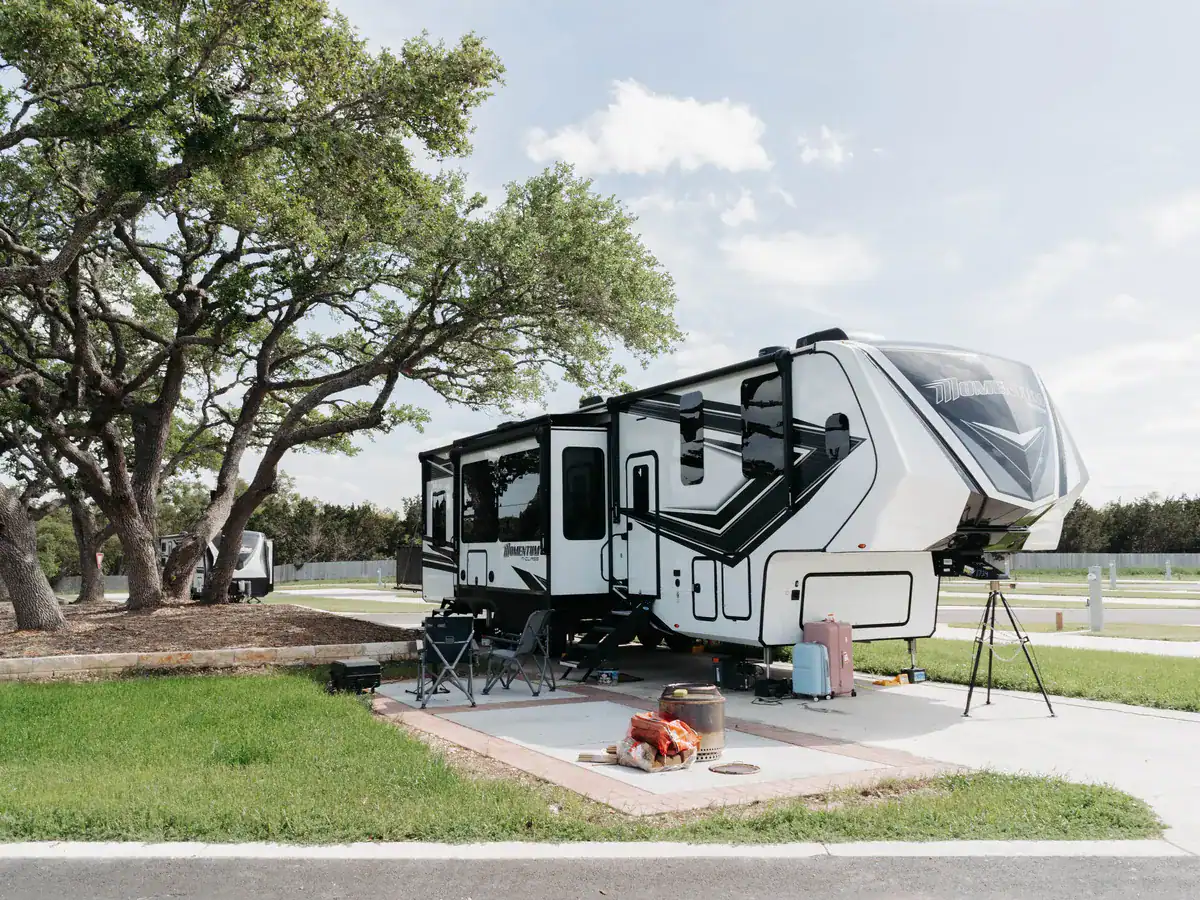
If you are traveling in an RV, our travel trailer packing checklist covers the gear that overlaps between the two styles.
Can You Work Remotely While Glamping or Camping?
Remote work outdoors is doable, but your setup matters. Horseshoe Ridge offers fiber Wi-Fi and hardwired pedestal internet, so both cabins and full-hookup RV sites can support meetings and uploads. Primitive camping usually cannot, since cell coverage is spotty to none in remote areas.
Cabins give you an indoor, private space with natural light, a proper desk or table, and stable lighting for video, so they need the least setup for a professional call.
Full-hookup RV sites shine when you need continuous 30- or 50-amp power and a wired pedestal connection that keeps uploads steady during long meetings. Outfit the rig with a good chair and an external monitor and an RV site can match a cabin for productivity.
For longer, dependable stays, our monthly RV stays list fiber and hardwired hookups. Stays of 30 or more days are arranged by phone rather than online, so call 737-307-2288 to set one up.
Before you commit, verify on the listing:
A quick tip: run a speed test on your phone in the exact spot you would work, at the time you usually work. Zoom recommends roughly 3 Mbps upload for a single HD stream, so watch your upload numbers. If they dip, ask about hardwired options or a quieter site.
Safety, Health, and Environmental Trade-Offs
Glamping and camping carry different trade-offs. Built infrastructure at a glamping site lowers sanitation and insect risks, but it uses more energy than a leave-no-trace campsite. Neither option is automatically low-impact; operator choices, guest behavior, and local ecology decide the net footprint.
Responsible operators reduce impact with efficient lighting, propane or solar systems, and consolidated pathways that limit soil compaction. You can read how we approach this on our conservation efforts page. To minimize your own footprint, use provided facilities, pack out trash, and follow local fire rules.
How Current Sustainability and Accessibility Standards Shape Your Choice
Recent sustainability and accessibility expectations are reshaping what travelers look for and what operators disclose. Municipalities have tightened short-term-rental rules for non-traditional structures like yurts and safari tents, third-party eco-certifications have grown, and platforms now surface accessibility details earlier in search.
For you, that means a few things are easier to compare up front:
Treat eco-badges and accessibility labels as a starting point, then verify the underlying proof before you finalize a booking.
What to check before you book:
How to Choose: A 5-Question Decision Guide
At Horseshoe Ridge in Wimberley, Texas Hill Country, the decision usually comes down to five quick questions:
When your top two priorities disagree, rank them and pick the option that meets both at an acceptable level. Comfort plus immersion often lands on a cabin. Cost plus connectivity is a judgment call: weekend visitors usually protect the budget, while remote workers protect the connection.
Read recent reviews for repeated themes rather than single comments, and study guest photos for site layout and spacing before you commit.
Frequently Asked Questions
What exactly counts as "glamping"?
Glamping is camping with added comforts and services. Typical features include a furnished cabin or luxury tent, electricity, made beds, and on-site amenities like a pool or store.
Is glamping better than camping for a romantic getaway?
Often, yes, because glamping favors comfort and privacy. A quiet cabin with a fire pit and a scenic view sets the mood without extra planning. Our romantic cabin tips walk through how to plan one in Wimberley.
Are glamping sites pet-friendly?
Policies vary by property, but at Horseshoe Ridge, all cabins are pet-friendly and pets are welcome resort-wide, with a few simple rules on leashing and vaccinations.
Can I work remotely while glamping?
Yes, when the property provides reliable internet. Horseshoe Ridge offers fiber Wi-Fi and hardwired pedestal internet, so plan a quiet corner and confirm connectivity before a video call or a large upload.
How much does glamping cost?
Rates depend on the accommodation type, the season and any added services. Glamping generally costs more per night than a primitive tent site, though it removes the upfront gear spend that camping requires.
How do I choose between a yurt, cabin, tent, or RV?
Match the lodging to your priority. A cabin is comfort, privacy, and convenience. A yurt is a novel stay with moderate amenities. A tent is minimalist and close to nature. An RV brings mobility plus hookups and resort comforts.
Do I need to bring camping gear for glamping?
Usually not. Most glamping units include beds, linens, and basic amenities, so you bring personal items and any specialty gear you prefer. Always check your reservation for what's provided.
Is glamping suitable for families?
Yes. On-site bathrooms, staff nearby, and predictable sleep spaces make supervision easier and evenings calmer. Look for units with multiple beds and amenities like a pool to keep kids engaged.
Can I bring my RV for a glamping-style stay?
Yes. A full-hookup premium site with resort amenities delivers a glamping-style RV experience. Site types and hookups are listed on the RV sites page.
How do I book a glamping-style stay at Horseshoe Ridge?
Book short stays through the resort's online system. For stays of 30 or more days, or if you have questions about pet policies or site types, call 737-307-2288.