RV resort community culture is the set of shared habits and courtesies that turn a row of parked rigs into a neighborhood. At a resort like Horseshoe Ridge in Wimberley, TX, that culture is shaped as much by how the full-hookup RV sites are laid out as by the people staying in them.
It shows up in small ways. A wave from the site across the road. A spotter appearing as you start to back in. A fire pit conversation that runs long past dark.
RV resort community culture runs on shared space, light-touch neighborliness, and a handful of unwritten rules about noise, privacy, and helping out. Knowing those rules makes any resort feel like home faster. Ready to book? Call 737-307-2288 or reserve online.
What Is RV Resort Community Culture?
RV resort community culture is the informal social agreement among guests living close together, temporarily, by choice. It is different from a campground and different from a hotel.
In a hotel, you share hallways. At an RV resort, you share sightlines, weather, utility pedestals, and a laundry room. Most people arrive already knowing that.
Three things make it distinct:
The result is a culture that reads as warm but not intrusive. People help, then leave you alone.
Why Community Matters More at an RV Resort Than at a Roadside Stop
An overnight lot is a place to sleep. A resort is a place to stay, and staying changes what guests want from the people around them.
Travelers who book multiple nights tend to want three things from the community:
All three are easier to find when a property is built for it. Clustered shared amenities create natural gathering points, so guests end up in the same place at the same time without anyone having to organize it.
Practical help is the underrated part. Backing a 40-foot fifth wheel into a site is easier with a spotter. A neighbor who has been on the property a month knows which sites get the most oak shade in August.
The Unwritten Rules Every RVer Should Know
Every resort posts its own rules, and those are the ones that count. Underneath them sits a layer of etiquette that nobody writes down and everybody notices.
Respect the Invisible Property Lines
Your site is your yard. So is your neighbor's. Do not cut through an occupied site to reach the bathhouse or the pool, even when it saves fifty steps. Walk the road.
It is the most commonly broken rule at any resort, and the one that generates the most quiet resentment.
Keep Noise Inside Community Hours
Sound carries farther between rigs than most people expect, especially at night. Horseshoe Ridge posts quiet hours from 10 PM to 8 AM, which is typical across the industry.
Outdoor speakers, TV volume, and late arrivals all fall inside that window. Generators are prohibited except by written management permission, which removes the most common noise complaint entirely.
Offer Help, Then Step Back
The standard is simple. Ask once, help if the answer is yes, and go back to your chair if the answer is no.
Backing into a site is the classic example. One spotter is welcome. Three spotters and a round of unsolicited advice are not.
Handle Pets, Kids, and Wheels Like a Neighbor
Pets are welcome across the resort, up to three per campsite and two per cabin, and each one belongs on a six-foot leash outside your site. Children under 14 need an adult with them anywhere on the property, including the pool.
The speed limit is 5 mph and it is enforced, which matters when kids on bikes and golf cart rentals share the same roads. Drones are not permitted over campsites or common areas.
Follow the Fire Rules Without Being Asked
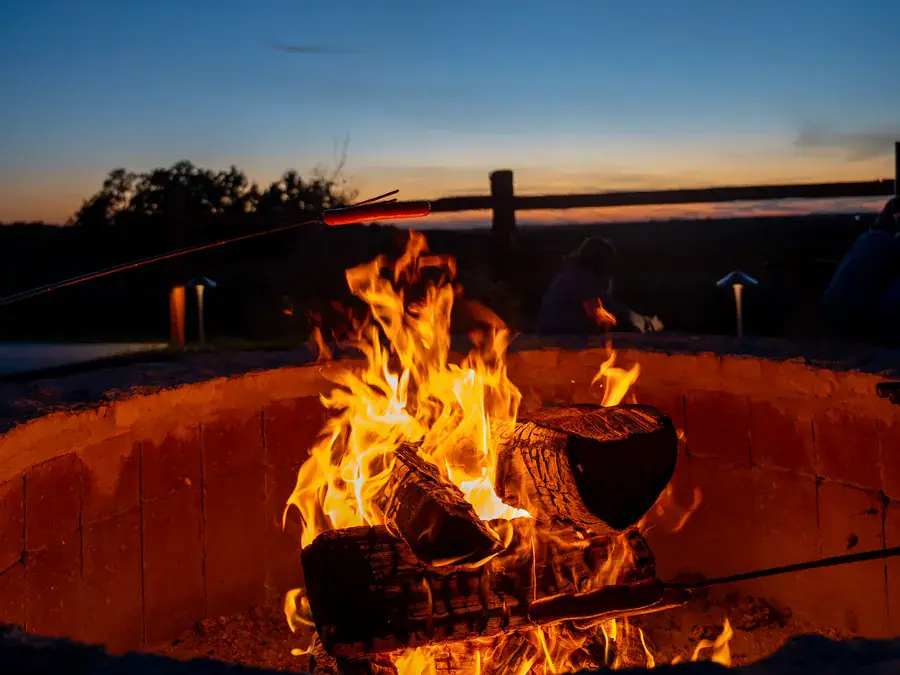
Central Texas fire danger is real, so guests bring their own propane fire pits to the RV sites, and wood fires stay at the community fire pits by the amenity center. No charcoal grills.
Guests who already know this and comply without a reminder are the ones who make a resort easy to run.
Where Community Actually Happens
Community does not form in the abstract. It forms in specific places, and knowing which is which shortens the learning curve at any new property.
| Space | What Happens There | Best For |
|---|---|---|
| Resort-style pool and pool deck | Afternoon overlap, casual introductions, families crossing paths | Meeting people with zero commitment |
| Pickleball courts | Rotating doubles, standing games, friendly rivalry | Repeat contact over several days |
| Outdoor kitchen | Shared cooking, potluck setup, group meals | Rally groups and multi-family stays |
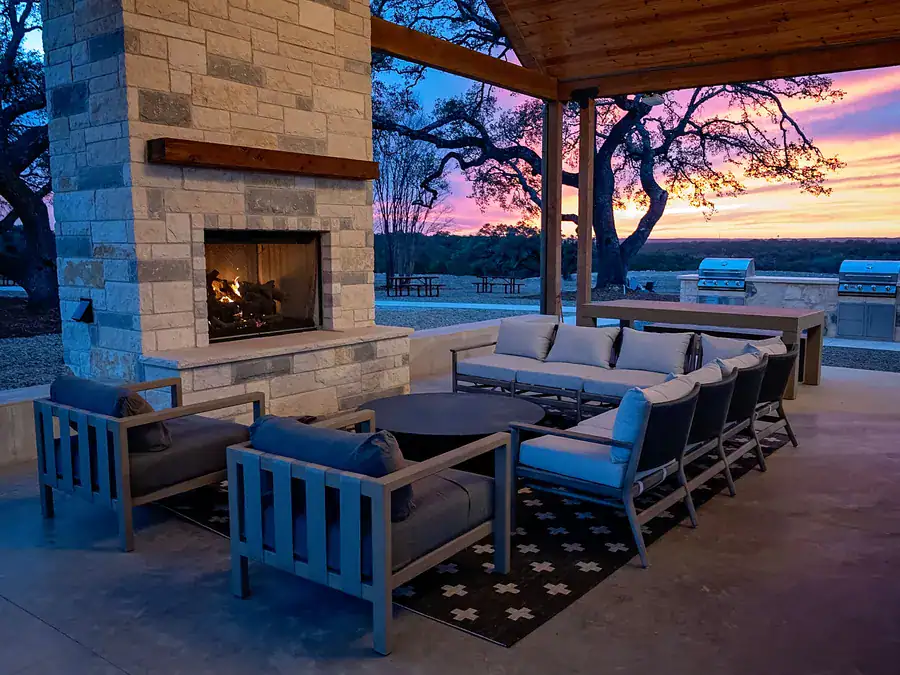
| Fire pit area | Evening conversation, the longest talks of the day | Winding down and swapping route notes |
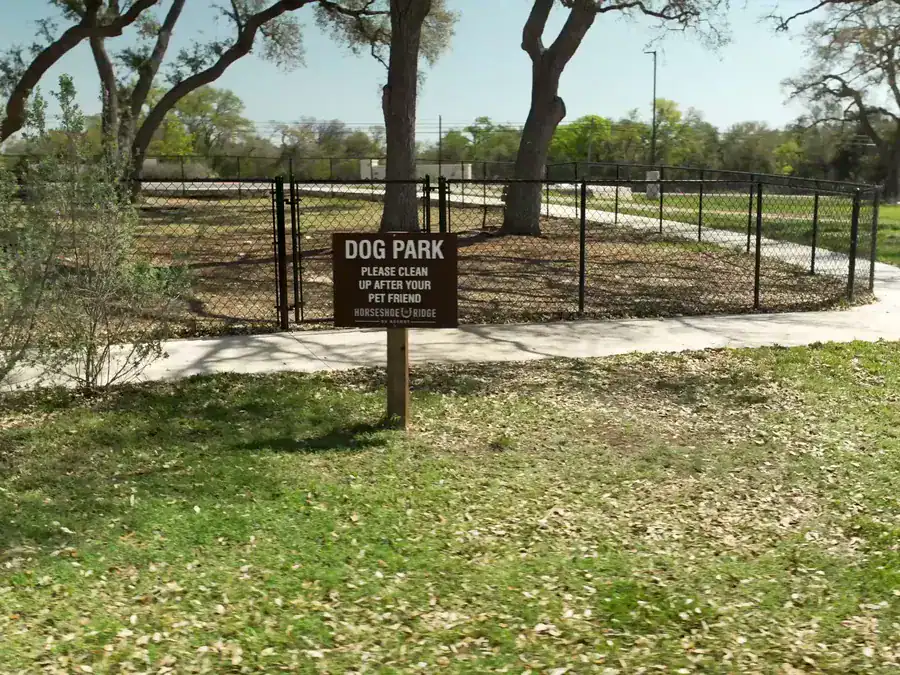
| The dog park | Dog owners swapping stories while the dogs play | Quieter guests and early risers |
| Laundry and bathhouse | Short practical exchanges, local tips | Anyone who wants information fast |
The pattern holds almost everywhere. Daytime spaces produce introductions, evening spaces produce conversations, and the posted activities schedule tells you which of them will be busy on a given day.
Who You Will Actually Meet on the Row
The retiree stereotype has not been accurate for a long time. A modern resort row is mixed, and the mix is what makes it interesting.
| Traveler Type | What They Are Usually After | How They Show Up in the Culture |
|---|---|---|
| Long-term and monthly guests | A seasonal base, routine, reliable utilities | Set the tone, know everyone, hand down local knowledge |
| Weekend and vacation travelers | A short reset close to home | High energy, high turnover, quick to say hello |
| Remote workers and digital nomads | Fiber Wi-Fi, hardwired pedestals, quiet daytime hours | Visible at the pool after 5 PM, invisible before it |
| Families | Pool time, safe roads, things for kids to do | Drive daytime activity across the whole property |
| RV clubs and rally groups | A block of sites and a place to gather | Bring their own culture with them for a few days |
| Destination wedding parties | Group lodging near a Hill Country venue | Short, social, tightly clustered stays |
Nobody has to fit one of these, and plenty of guests are two of them at once. Cabin guests sit inside the same amenity cluster and the same social rhythm, without owning a rig at all.
How Long-Term Guests Shape the Culture
The people who stay longest set the standard, at every resort. They know which sites get afternoon shade, which loop the deer walk at dusk, and who to call about a pedestal issue.
New arrivals read that behavior and match it. A resort with a stable long-term core feels settled within an hour of pulling in.
If you are weighing an extended stay yourself, monthly RV stays work differently from a weekend booking. Online reservations cover stays under 30 days, and stays of 30 days or more are arranged by phone at 737-307-2288.
That call is also the moment to ask about site placement, which matters far more over a season than over a weekend.
Rally Groups and Traveling Clubs
Clubs bring a ready-made community and drop it onto the property for a few days. Brand clubs, chapter groups, veteran and faith-based groups, and RVing women's groups all travel this way, usually under a single wagon master.
The mechanics are worth knowing before you plan one. Rallies at Horseshoe Ridge start at 10 sites traveling together under one group, with a two-night minimum, and members book as part of the group but pay individually.
Groups gather outdoors on the pool deck, outdoor kitchen and fire pit area, and indoors in the Lounge. All of these spaces are shared with other guests and can't be reserved privately.
Rally stays are quoted rather than booked online. The path is the request form on the rally groups page or a call to 737-307-2288.
How to Plug Into a New Resort in Your First 48 Hours
None of this is required. Guests who want a quiet week get a quiet week, and that is a perfectly good way to use a resort.
What Community Culture Looks Like at Horseshoe Ridge
Horseshoe Ridge sits on 31 acres of Wimberley oak country with 15-mile Hill Country views, roughly 45 minutes from Austin and 70 minutes from San Antonio.
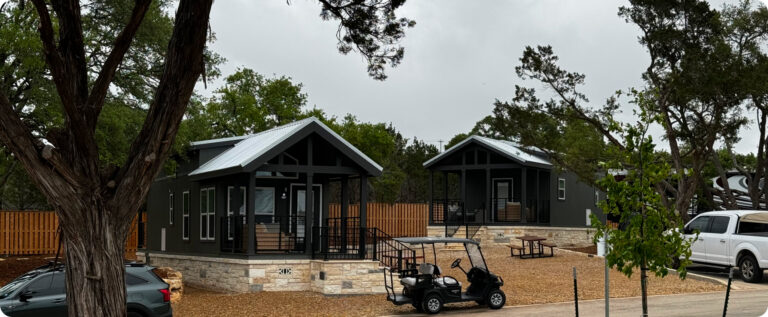
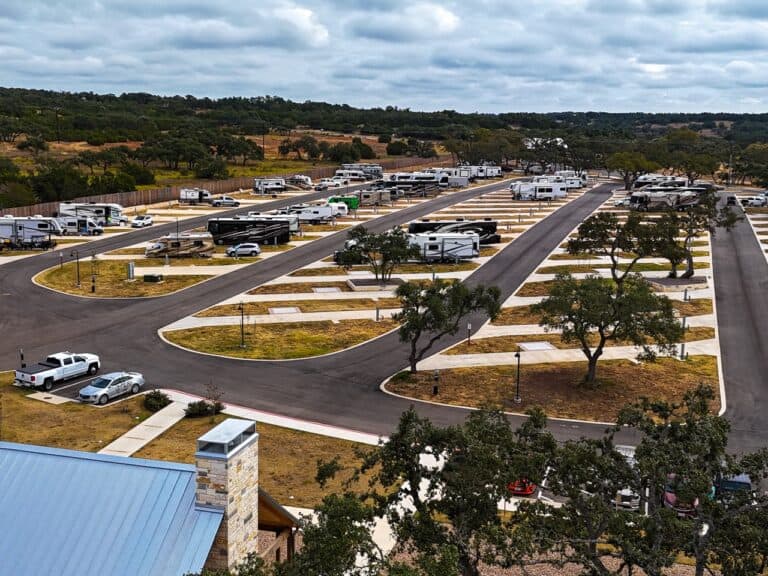
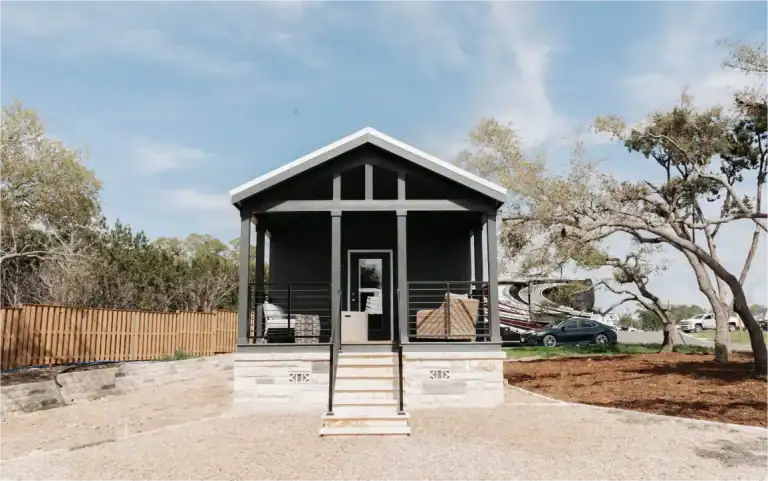
The property has 124 full-hookup RV sites across Premium, Executive, and Deluxe tiers in pull-through and back-in configurations, plus three cabins: Sea Biscuit, Secretariat, and The Mingo.
Layout does a lot of the community work here. Sites are sized for big rigs, so neighbors are close enough to wave at and far enough apart for a quiet evening. The pool, courts, outdoor kitchen, and fire pit area all sit within a short walk of each other.
Wimberley itself contributes something no property can manufacture. Ask a neighbor what to do with a free afternoon and you will get a strong opinion, usually one of the best things to do in Wimberley, delivered with the confidence of someone who has already been twice.
The valley is also a recognized International Dark Sky Community, one of a small number in Texas, and the community has worked to keep it that way.
On a clear night, the fire pit conversation tends to stop mid-sentence when somebody looks up. Hill Country weather can shift quickly, so check current conditions before day trips.
Frequently Asked Questions
Do I have to be social at an RV resort?
No. Community culture at an RV resort is opt-in. Chairs out and awning down signals that you are open to conversation, and a closed-up rig signals that you would rather not be. Both are completely normal, and neither one requires an explanation to anybody.
What are quiet hours at an RV resort?
Most RV resorts set quiet hours from roughly 10 PM to 8 AM, and Horseshoe Ridge follows that window. Quiet hours cover outdoor speakers, TV volume, late arrivals, and conversation volume outside your rig. Our full rules and policies page has the rest, including the written-permission rule for generators.
How do I meet people if I am traveling solo?
Shared amenities are the easiest entry point. Pickleball, the pool deck, and the fire pit area all produce conversation without anyone having to organize anything. Walking a dog is the most reliable introduction on any property. Dropping into whatever activity is running that week works just as well.
Are RV resorts only for retirees?
No. The mix now includes remote workers, families, weekend travelers from Austin and San Antonio, wedding parties, and full-timers of every age. Fiber Wi-Fi and hardwired pedestals have made extended stays practical for people who still work full time, which has widened the age range considerably.
Can I bring my dog into the community areas?
Pets are welcome resort-wide at Horseshoe Ridge, up to three per campsite and two per cabin, and all cabins are pet-friendly. Pets belong on a six-foot leash outside your site and are not permitted inside resort buildings, restrooms, or the pool fence. Current vaccination records should travel with you.
What should I do if a neighbor is breaking the rules?
Bring it to the office rather than to the neighbor. Staff handle it routinely and impersonally, and the posted rules give them something neutral to point at. Direct confrontation between guests is the fastest way to make a week uncomfortable for everyone on the row.
Is community culture different for monthly guests?
Yes, in degree rather than in kind. Monthly and long-term guests know the property and each other, so the social layer is deeper and slower moving. They also become the informal welcome committee for new arrivals. Stays of 30 days or more are arranged by phone at 737-307-2288.
Can my club or rally book together?
Yes. Pricing for rally groups applies to 10 or more sites traveling together under one group or wagon master, with a two-night minimum. If your dates include a Friday or Saturday, both weekend nights are required. Rally stays are quoted individually, so start with the request form or a call to 737-307-2288.
Are there rules about campfires and grilling?
At Horseshoe Ridge, guests can bring their own propane fire pit to their RV site, and wood fires are welcome at the community fire pits by the amenity center. Charcoal grills are not permitted, which reflects Central Texas fire danger and drought conditions. Never leave a fire unattended, including a propane one.
Can I bring my own golf cart?
Golf carts are common on the property, and rentals are available on site. Anyone operating a motorized vehicle, including an e-bike, needs a valid driver's license. The 5 mph speed limit applies to every vehicle on the roads.